REVIEW · SEVILLE
12 o’Clock – Bike & Tapas Tour Seville
Book on Viator →Operated by Seebybike · Bookable on Viator
Seville looks different from a bike seat. This 12 o’clock tour mixes major landmarks with neighborhood wandering, and it does it on a comfortable, geared bicycle. You get a clean first-pass orientation of the city without spending your whole day stuck in lineups.
I especially love the small group size (max 8), because the guide can slow down and answer real questions. I also like that lunch with alcoholic beverages is built into the experience, so the afternoon plans don’t fall apart the moment you’re hungry.
One consideration: the route is fast and the stops are short, so you’ll see a lot of Seville, but it’s not a tour where you linger for long inside every monument. If you’re hoping for hours inside big-ticket sites, you’ll still want to come back on your own.
In This Review
- Key highlights worth paying attention to
- Getting bearings fast on two wheels
- The 12:00 start: why midday works for tapas and pacing
- Catedral exteriors and Barrio Santa Cruz: the medieval maze feeling
- Real Alcázar exteriors: Moorish, Gothic, Mudéjar in one glance
- Torre del Oro and the Giralda: symbols you’ll recognize later
- Triana: tiles, pottery, and flamenco culture
- Plaza de España and Parque de María Luisa: the postcard scale
- A working look at the Real Fábrica de Tabacos
- Iglesia de Santa Ana and Palau de San Telmo: older layers, different moods
- Plaza de América: 1929 and the surrounding style mix
- Guides make the difference: names you might hear
- Value and what $155.42 really covers
- Best for who (and who should plan differently)
- Should you book the 12 o’clock Bike & Tapas Tour Seville?
- FAQ
- How long is the Seville 12 o’clock Bike & Tapas Tour?
- What time does the tour start?
- Is the tour offered in English?
- How many people are on the tour?
- What’s included with the tour?
- Where does the tour meet?
- Do you spend time inside monuments or mostly see exteriors?
- Is good weather required, and can I cancel?
Key highlights worth paying attention to
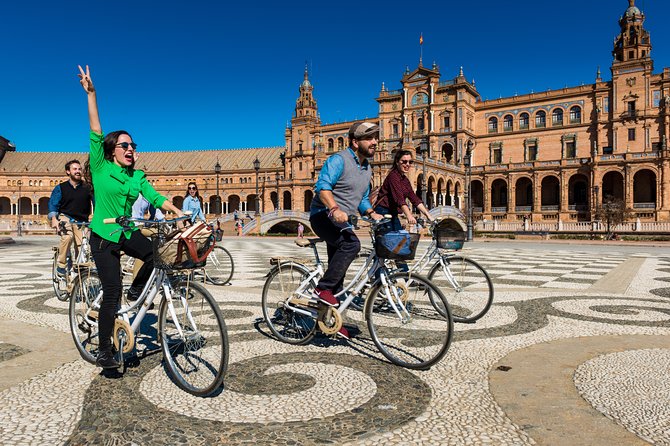
- Max 8 riders keeps the ride personal, not a herd
- Lunch plus alcoholic beverages means you’re fed without hunting for a place
- Bikes, helmets, baskets, and maps are included, so you can travel light
- Classic Seville neighborhoods like Barrio Santa Cruz and Triana come with context, not just photos
- Big-photo landmarks along the way: Torre del Oro, Giralda, Plaza de España
- A guided route through multiple eras: Moorish, Gothic, Mudéjar, Renaissance styles show up everywhere
Getting bearings fast on two wheels
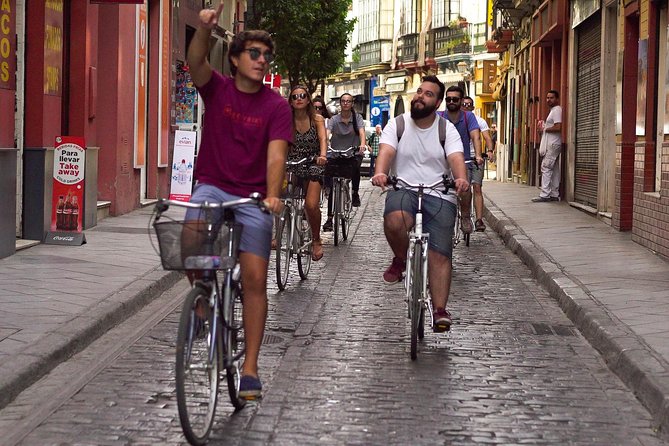
If you’re in Seville for only a few days, this is the kind of tour that sets you up for the rest of the trip. I like that the plan is focused: major sights first, then neighborhood texture, so you start recognizing streets and landmarks as you explore on your own later.
The bike format matters here. Seville’s core is laid out in a way where a ride helps you cover ground without burning your legs. You’re also less stuck with the stop-and-go rhythm you’d get if you were hopping between taxis and separate entrances. And because the group is small, you’re not constantly waiting on the slowest person—or trying to squeeze your way through the same crowd.
The tour is offered in English, lasts about 3 hours, and you ride with gear provided: bikes, helmets, baskets, and maps. There’s also a mobile ticket, which is handy if you like keeping everything on your phone.
You can also read our reviews of more tours and experiences in Seville.

The 12:00 start: why midday works for tapas and pacing
Starting at 12:00 pm is a smart choice for two reasons. First, it hits the moment when you can still enjoy daylight for the big monuments. Second, it’s timed so that lunch fits naturally into the flow instead of turning the tour into a scramble.
You also end back at the meeting point, so you don’t end up stranded across town with no clear next move. That’s a small thing, but it changes how relaxed your afternoon feels.
In terms of pacing, expect quick stops. Many of the stops are timed around exterior viewpoints or brief orientation moments. You’ll spend time looking, listening, and getting pointed in the right direction rather than sitting down for long museum-style experiences.
Catedral exteriors and Barrio Santa Cruz: the medieval maze feeling
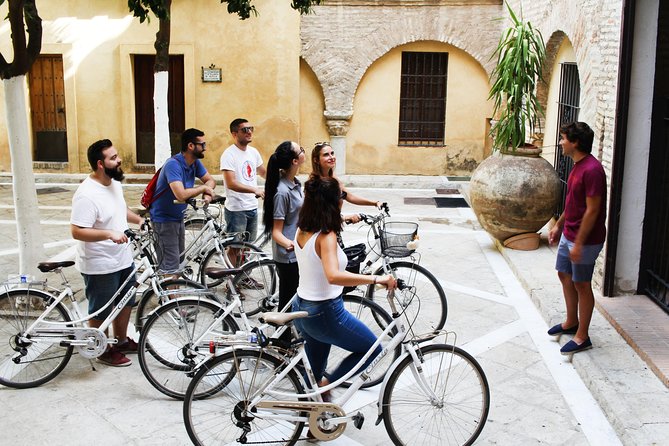
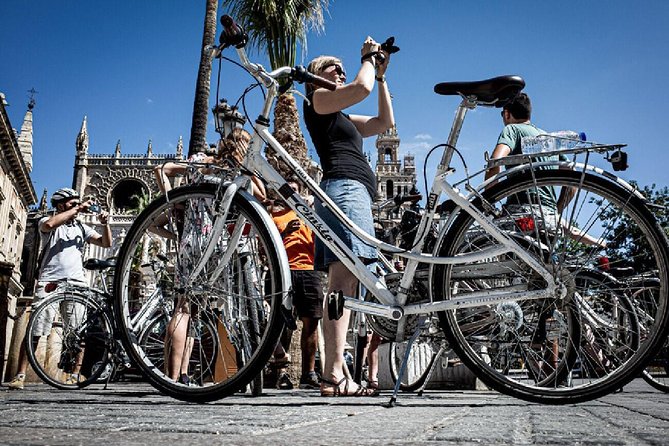
The ride kicks off with the Catedral de Sevilla from the outside. Even if you don’t go inside, it’s worth it for the sheer Gothic scale. It’s described as the biggest Gothic cathedral in the world, and when you stand near it, you feel why people treat it like a city within a city.
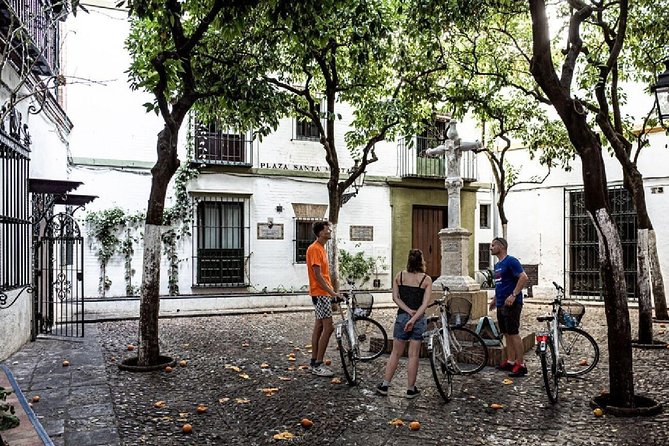
From there, you head into Barrio Santa Cruz, the historic heart of Seville and once the medieval Jewish quarter. This is the part you’re meant to get lost in—romantic squares, narrow alleys, and the kind of street corners that make you stop without meaning to. On a bike tour, you get a taste of the neighborhood without having to map every turn first.
A quick tip for enjoying this segment: don’t just look forward while you’re riding. When the guide pauses, take the time to look at the street lines and the way buildings step back from the walkway. That’s how you start understanding why Seville’s old quarters feel so intimate.
Real Alcázar exteriors: Moorish, Gothic, Mudéjar in one glance
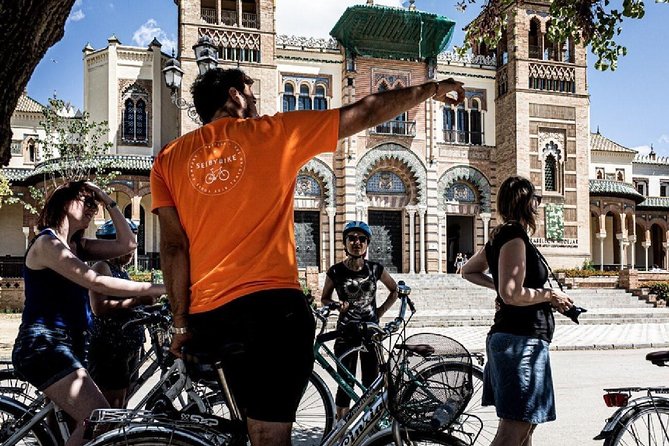
Next up is the Real Alcázar de Sevilla, again from the outside. Even in a short stop, the key idea lands: it’s a royal palace mixing multiple styles—Moorish, Gothic, Mudéjar, and Renaissance elements. If you’ve been hearing those style words on your trip and wondering how they connect, this is where they become visible.
The practical takeaway for you is this: once you’ve got the Alcázar in your brain as a style-collision place, it’s easier to notice those details everywhere else you walk later. You’ll start spotting ornamental touches and architectural blending on your own.
If you’re a detail hunter, you might want to plan a longer, separate visit to the Alcázar after the tour. The bike ride gives you the orientation; a deeper visit gives you the time.
Torre del Oro and the Giralda: symbols you’ll recognize later
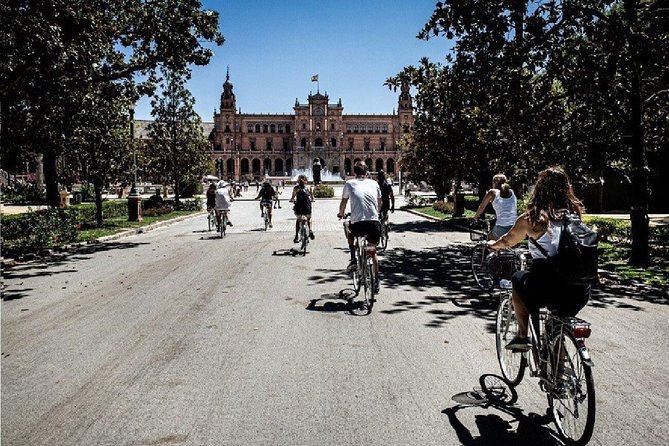
You’ll also see Torre del Oro, one of Seville’s most photographed landmarks. It was built in the 13th century to control access to the port, so it’s not just an attractive tower—it ties to the way Seville connected to trade and the wider world.
Then the route brings you to Torre Giralda, the bell tower of the Seville Cathedral. The especially interesting point here is its origin as the minaret for the Great Mosque of Seville in al-Andalus. That means you’re standing near a structure that carries layers of cultural change, even if the surface looks like it belongs to one era.
This pair of stops is valuable because it helps you read Seville’s skyline. Later, when you spot these silhouettes from a distance, you’ll know what you’re looking at and why it matters.



Triana: tiles, pottery, and flamenco culture
Next comes Triana, a neighborhood with a traditional pottery and tile industry and a strong flamenco culture. Triana also has its own festivals, which is a hint that the area has a distinct identity rather than just being a “nice place to pass through.”
This is one of the stops where the guide’s storytelling can make the difference. When you understand that tiles and pottery aren’t random craft trivia but part of everyday neighborhood life, you’ll start noticing them on later walks—especially along facades and interior courtyards you might otherwise skip.
One practical consideration: this stop is shorter than some of the big monument viewpoints. Use it to get your bearings for future exploring. If Triana is the neighborhood you love most, you’ll get more out of it by returning after the tour for a longer wander.
Plaza de España and Parque de María Luisa: the postcard scale
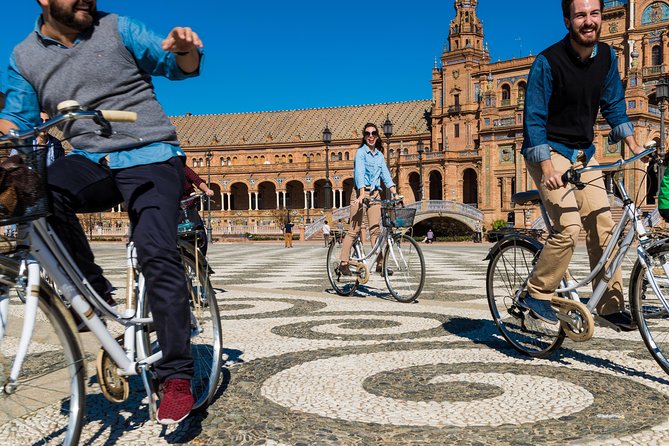
Plaza de España is the kind of place that makes your brain switch modes from street-level to “wow, scale.” It’s one of Seville’s most impressive landmarks, tied to the 1929 Exposiciones Universales. In other words, it’s built as a showpiece, and you feel that in the broad layout and grand geometry.
Right after, you move into Parque de María Luisa, the large green area next to Plaza de España. The description you’ll hear is practical and sensory: shady avenues lined with exotic trees, fairy-tale style buildings, Moorish fountains and pools, plus colorful tiled benches. This is a good stop for catching your breath after the older stone streets.
A small way to get more from the park: when the group pauses, look for tilework and water details. Those are the visual clues that connect the park’s design to Seville’s broader craft traditions.
A working look at the Real Fábrica de Tabacos
One of the more interesting timing notes on the route is the visit to Real Fabrica De Tabacos. While it’s now the University of Seville, the tour includes time to have a look inside.
This is a different kind of stop than the exterior monuments. Instead of you just taking photos, you get a chance to see how a historic factory building functions in a modern context. If you’re curious about how Seville’s past shapes its present institutions, this is where the tour earns its keep.
Iglesia de Santa Ana and Palau de San Telmo: older layers, different moods
You’ll also stop by Iglesia de Santa Ana, dated to 1276, with a Gothic-Mudéjar style. The interior is described as high and vaulted, with religious imagery. Because the stop is brief, you’ll mostly be collecting impressions, but that’s often enough to decide whether you want to return for a longer look later.
Then there’s Palau de San Telmo, Seville’s finest example of the baroque style. It was originally constructed as the seat of the University of Navigators. That historical angle matters: it ties the building to Seville’s maritime mindset, not just to art style.
Plaza de América: 1929 and the surrounding style mix
The tour closes this arc with Plaza de América, also in Parque de María Luisa. The area is flanked by nearby museums in different architectural styles, and it connects to the Ibero-American exhibition of 1929.
For you, this final stop is less about checking off another landmark and more about synthesizing what you’ve been seeing all morning: Seville’s style shifts are not random. They’re tied to specific moments—conquests, royal tastes, world expos, and institutional needs—layered over time.
Guides make the difference: names you might hear
What shows up again and again is how entertaining the guides are—turning streets into stories, and stories into practical advice. Names you may encounter include Antonio, Javi, Antonio Caballos, Iván, and Miguel. The consistent theme: they don’t just recite facts; they point you toward what to notice and where to eat or drink afterward.
That last part is quietly important. A good guide gives you a short list of places you wouldn’t easily find on your own, plus recommendations for what to do next, like where to catch flamenco. It’s the kind of support that helps you travel with intention instead of guessing.
Value and what $155.42 really covers
At $155.42 per person for about 3 hours, the price is easiest to evaluate by looking at what’s included.
You’re getting:
- Guided sightseeing of major Seville icons and neighborhoods
- Bike gear: bikes, helmets, baskets, and maps
- Lunch with alcoholic beverages included
- A small group capped at 8 travelers
- English language guiding
- A route that hits multiple big “you must see this” sites without you planning each stop
If you’ve ever tried to piece together your own day—bike rental, helmet, lunch, and the cost of paying separately for guided help—the built-in structure is what justifies the total. You’re essentially paying for time saved plus direction. And because the tour is designed to run as a single flowing experience, you get less decision fatigue.
Just remember the earlier tradeoff: the stops are short. You leave with bearings, not a full museum day.
Best for who (and who should plan differently)
This tour fits you if:
- You want a fast, guided way to learn the city layout early
- You like biking and want help choosing what to prioritize
- You prefer small-group attention over big-bus schedules
- You want lunch and drinks handled so your day stays relaxed
You might want a different plan if:
- You need lots of time inside major monuments as part of the same session
- You’re a slow walker who hates short stops
- You want a purely food-focused tapas crawl with lots of separate tastings (this is structured around sightseeing first, then lunch)
Should you book the 12 o’clock Bike & Tapas Tour Seville?
I’d book it if you’re aiming for a strong first day in Seville. The mix of big landmarks (Catedral area, Giralda, Torre del Oro, Plaza de España) and neighborhoods with a real identity (Barrio Santa Cruz and Triana) is exactly what helps you feel oriented fast. Add in the small group setup and the included lunch with alcoholic beverages, and you get a day that’s both efficient and comfortable.
If your travel style is all about long interior visits, treat this as your orientation and come back later. As a guided ride that turns Seville into something you recognize, it’s a very solid use of time.
FAQ
How long is the Seville 12 o’clock Bike & Tapas Tour?
It runs for about 3 hours.
What time does the tour start?
The start time is 12:00 pm.
Is the tour offered in English?
Yes, the tour is offered in English.
How many people are on the tour?
The tour has a maximum of 8 travelers.
What’s included with the tour?
You get bikes, helmets, baskets, and maps. Lunch is included, along with alcoholic beverages. It also uses a mobile ticket.
Where does the tour meet?
The meeting point is C. Pastor y Landero, 4, Casco Antiguo, 41001 Sevilla, Spain.
Do you spend time inside monuments or mostly see exteriors?
Many stops are exterior views. The tour specifically includes time to look inside the Real Fabrica De Tabacos (today the University of Seville).
Is good weather required, and can I cancel?
The experience requires good weather. If it’s canceled due to poor weather, you’ll be offered a different date or a full refund. Free cancellation is available up to 24 hours in advance for a full refund.